Posted Date : August 22, 2026
Category : Renting Guides
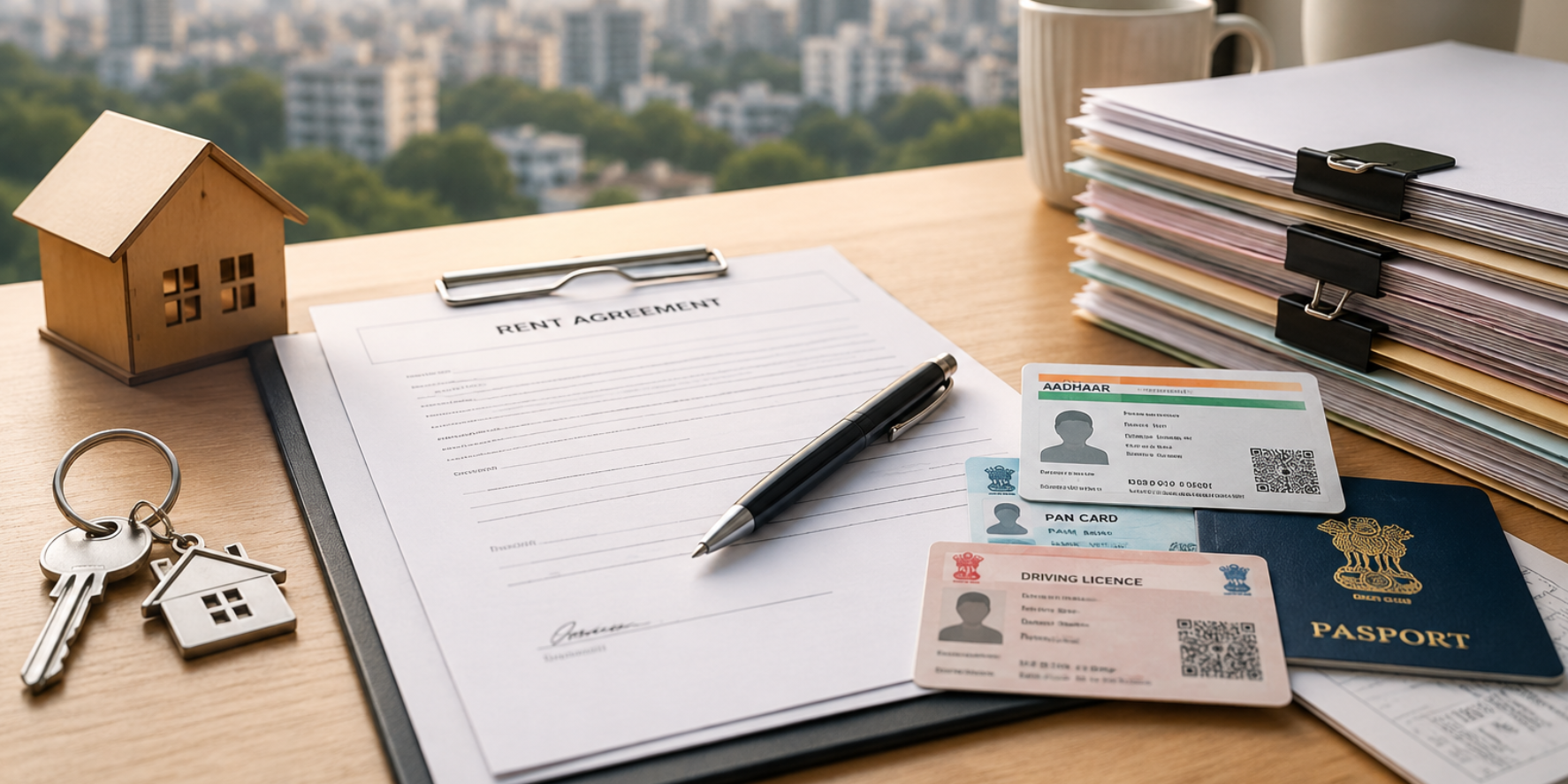
For a rent agreement in Mumbai, both landlord and tenant need their Aadhaar and PAN card. The landlord also needs to prove ownership, usually with a property tax receipt, Index II, or sale deed, while the tenant needs basic address proof. You'll also need two witnesses on hand with their own ID, and a Society NOC if the building asks for one. None of this is optional, either, since registration is compulsory under the Maharashtra Rent Control Act, 1999, no matter how short the agreement is.
If you're renting in a managed, gated-community project, most of this paperwork is collected and verified for you before you even see the flat. More on that below.
Renting a flat in Mumbai usually starts with the fun part: shortlisting societies, checking out the gym and the parking, figuring out which floor gets the sea breeze. Then the agreement stage arrives, and someone asks for your Aadhaar, your landlord's Index II, and two witnesses with photo ID, and suddenly the whole thing feels like paperwork you didn't sign up for.
It doesn't need to be confusing. Maharashtra has a fairly standard document list for rent agreements, it's just spread across landlord requirements, tenant requirements, witness requirements, and a few special cases nobody explains clearly. This guide puts all of it in one place, organised by who needs what, so you're not scrambling for a missing paper on the day of registration.
The landlord (called the "licensor" in Mumbai's Leave and License system) has to prove three things: who they are, where they live, and that they actually own the property being rented out.
The tenant (the "licensee") needs less paperwork than the landlord, but it still has to be current and correctly matched to their legal name.
If you're new to Mumbai and don't have a local address yet, this isn't a dealbreaker. Your Aadhaar with your home-state address is accepted for registration. You update your address details later once you've settled in.
Every registered rent agreement in Maharashtra needs two witnesses, and this part is often missed until the last minute.
Witnesses don't need to be related to either party. Friends, colleagues, or neighbours can act as witnesses, as long as they're available on registration day with their ID.
Most document checklists online only talk about NRI tenants. Landlords living abroad get overlooked just as often, so here's both sides.
This part rarely shows up in generic guides, but it matters a lot in premium Mumbai projects, the kind with a clubhouse, a gym, and an active managing committee.
When you're renting through a managed platform, this coordination between the landlord, the society, and the registration process is typically handled on your behalf, which is one of the bigger practical differences between a managed rental and a direct landlord deal.
A little preparation avoids most of these:
Yes. Under Section 55 of the Maharashtra Rent Control Act, 1999, every rent agreement in Mumbai must be registered, regardless of how long the tenancy is, even an 11-month agreement. An unregistered agreement holds far less legal weight if a dispute comes up later, and many banks, employers, and housing societies won't accept it as valid address proof.
Registration also involves stamp duty, which is calculated separately based on your rent and deposit amount. We've covered that in detail, including a worked example, in our guide on Stamp Duty and Registration Charges for Rent Agreements.
Once your agreement is registered, most Mumbai police stations expect landlords to file a tenant verification form for the local jurisdiction. This is a separate, simple step from the rent agreement itself, but it's often confused with it. You can find the official tenant verification form directly on the Mumbai Police website. It typically just needs the tenant's ID and a copy of the registered agreement.
If this list feels like a lot to track (landlord documents, tenant documents, witness availability, society sign-offs), that's fairly normal for a first-time renter in Mumbai. It's also exactly the kind of coordination RentMax handles as part of managing rentals in our partner gated communities.
Listings on RentMax come with ownership already verified and society formalities already sorted, so by the time you're ready to sign, the documentation gap between "what you need" and "what's already been checked" is much smaller.
The document list for a Mumbai rent agreement isn't complicated once it's broken down by who needs what: Aadhaar, PAN, and address proof from both sides, ownership documents from the landlord, and two witnesses on registration day.
Where people usually lose time is in the exceptions, like an outdated property tax receipt, an NRI landlord who needs a POA, or a society that's slow to issue an NOC. Sorting these out a few days in advance, rather than on the morning of registration, is really the only difference between a smooth move-in and a delayed one.
Not strictly mandatory for registration itself. Aadhaar is the primary document used for identity and biometric verification. However, PAN becomes necessary if the monthly rent exceeds ₹50,000 (the tenant needs the landlord's PAN to deduct TDS under Section 194-IB) or if a salaried tenant is claiming HRA above ₹1,00,000 a year.
Yes. DigiLocker Aadhaar or an e-Aadhaar downloaded from the UIDAI website is accepted for rent agreement registration in Maharashtra.
The property tax receipt in the landlord's name is generally sufficient as ownership proof. If needed, a certified copy of the sale deed can also be obtained from the Sub-Registrar's office where it was originally registered.
An NRI landlord typically needs to execute a notarised or apostilled Power of Attorney authorising someone in India to sign and register the agreement on their behalf, along with their passport copy and OCI card if applicable.
It depends on the society's internal rules. Many premium gated communities in Mumbai do require landlords to inform or get sign-off from the managing committee before a new tenant moves in. It's worth checking with the society office early in the process to avoid last-minute delays.
Two witnesses are required, and they need to be present with valid photo ID during biometric verification. They don't need to be related to either party. Friends, neighbours, or colleagues can act as witnesses.
Yes. Under Section 55 of the Maharashtra Rent Control Act, 1999, registration is compulsory for every rent agreement in Mumbai regardless of tenure, including short 11-month agreements.
A Leave and License agreement is the standard rental document used in Mumbai and across Maharashtra. It gives the tenant permission to occupy the property for a fixed period without transferring any ownership or tenancy rights, which lets the landlord recover the property more easily at the end of the term. A traditional lease, by contrast, creates a legal tenancy interest and offers the tenant stronger occupation rights. Most Indian cities use a standard lease, but Mumbai specifically uses the Leave and License format.
There's no fixed legal rule. In practice, stamp duty and registration charges are commonly split equally between the landlord and tenant in Mumbai, though this is a matter of mutual agreement rather than a statutory requirement. It's best to state clearly in the agreement who is responsible for these charges to avoid confusion later.
Yes. Maharashtra's Department of Registration and Stamps allows e-registration through Aadhaar-based OTP or biometric verification, and several private services also offer doorstep biometric registration, so a visit to the Sub-Registrar's office is often not required.